
Drafting
You’re not alone, part three

This series of posts under the general theme of “You’re not alone!” is based on a survey [link] of writing circumstances, in the sense of how one writes physically speaking. If you are interested in comparing your answers to the sample, you should stop reading now, go take the survey, and come back to this post afterward. On the contrary, if you are just curious of what people do, carry on, but then you should not take the survey after the fact.
Let’s start with the beginning: drafting. In a sense, Figure 8 offers no major surprises. of course the majority of writers drafts on the computer.
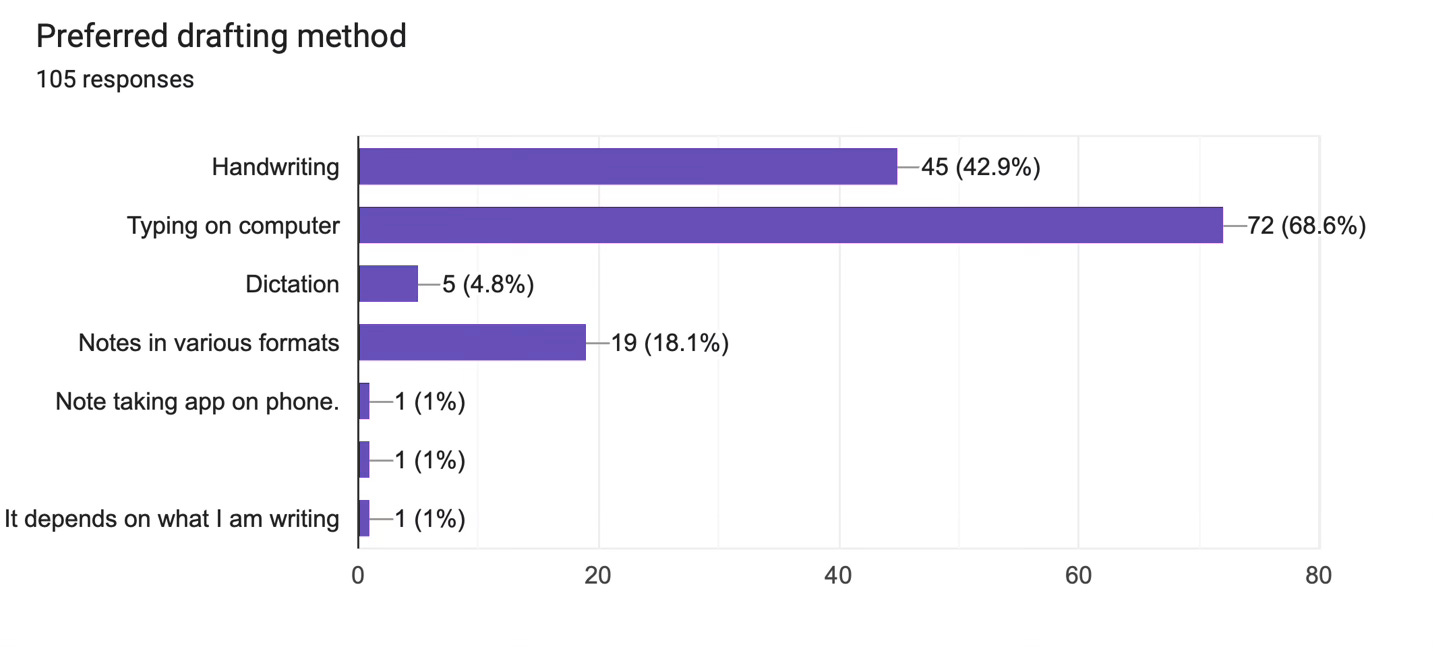
However, that more than 40% of the respondents drafts by hand is notable, for the same reason that the previous figure was predictable. In the age of the computer and Artificial Intelligence, using pen and paper is such a physical, visceral experience. Handwriting is wasteful: you have to copy your handwritten draft or notes into a computer file. Yet, precisely that act of converting handwriting to typed text is a powerful editing moment: the ephemeral becomes digital, replicable, practically print. For me personally, creative work started always from a handwritten draft. Academic writing I drafted directly in the computer. Hemingway, apparently, wrote longhand, in pencil, but would switch to the typewriter when the writing was “going fast and well.”1
Another potentially surprising result is that only a very small percentage of the respondents use dictation, whereas just shy of 20% starts from notes. To be honest, I take a lot of notes myself. I used to use any scrap of paper I would find handy, often ending up with napkins and coasters. I would staple these scraps to a sheet of paper and keep them as lucky charms, until I was done with the project, long after their usefulness had passed. Eventually, I graduated to the notes app on my phone, which has the advantage of synching to my computer. It’s less colorful, though.
With figure 9, we come to the scary stuff.
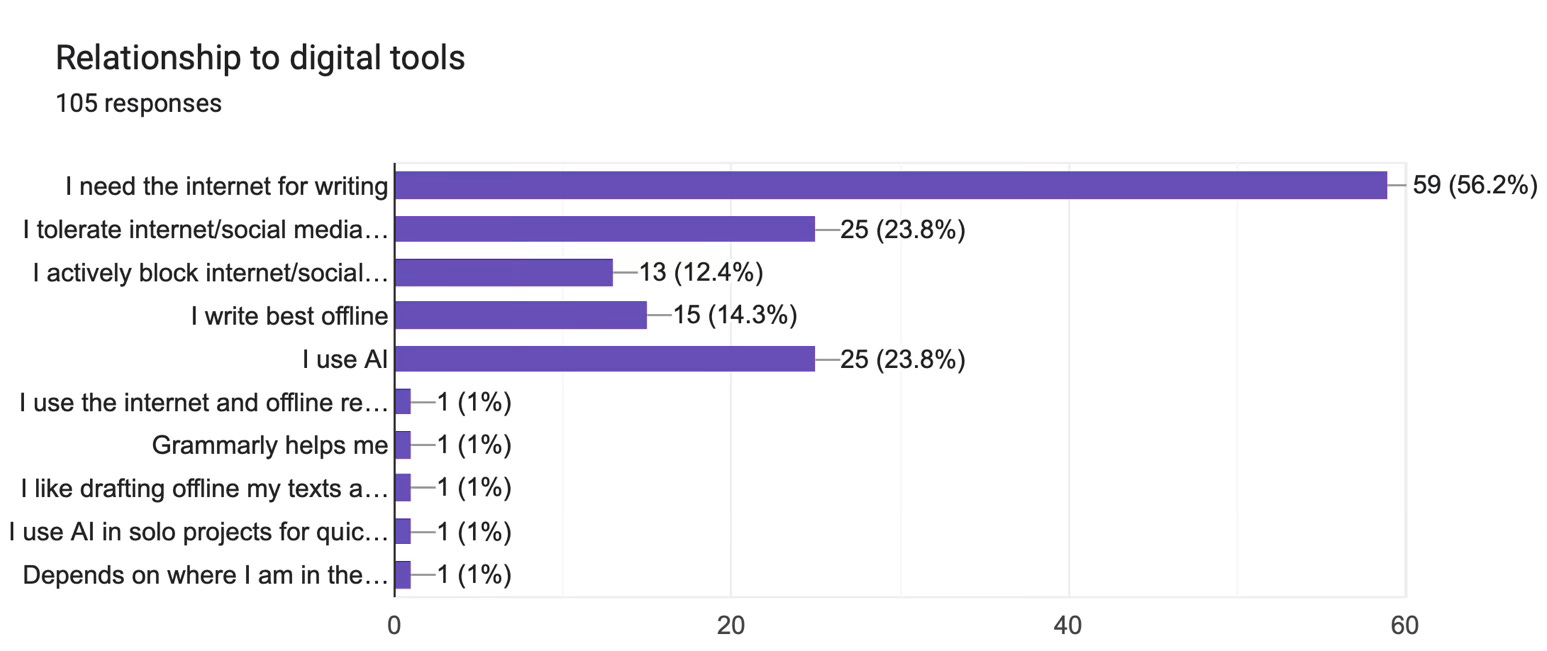
The majority of the writers we surveyed states they need the internet to write. Mind you I get it, and if you pressed me I would admit that I would actually be in that group (I did not take my own survey—of course!). Having a significant chunk of world knowledge at your fingertips, being able to fact-check details, such as dates of birth and death for authors, instantly or the year of publication of a book, were science fiction fifty years ago. Tools like Google scholar and Wikipedia, or the myriad of dictionaries, including the Urban Dictionary that we can summon with a few keystrokes are of course the reason why we feel we need the internet. And yet a non-indifferent number of people are a lot less enthusiastic about access to the internet while writing, with almost 15% stating that they write best offline. If I had to guess, the powerful lure of distraction is most likely why many people are skeptical of having access to the infinite circus that is the internet.
Of course, the really scary statistics is that almost a quarter of the respondents admits to using AI. Granted, my survey’s respondents skew young (mostly PhD students), but still one would have hoped that more people were aware of the risks inherent in using AI. This is not the time to go down that road so I will leave it at that.
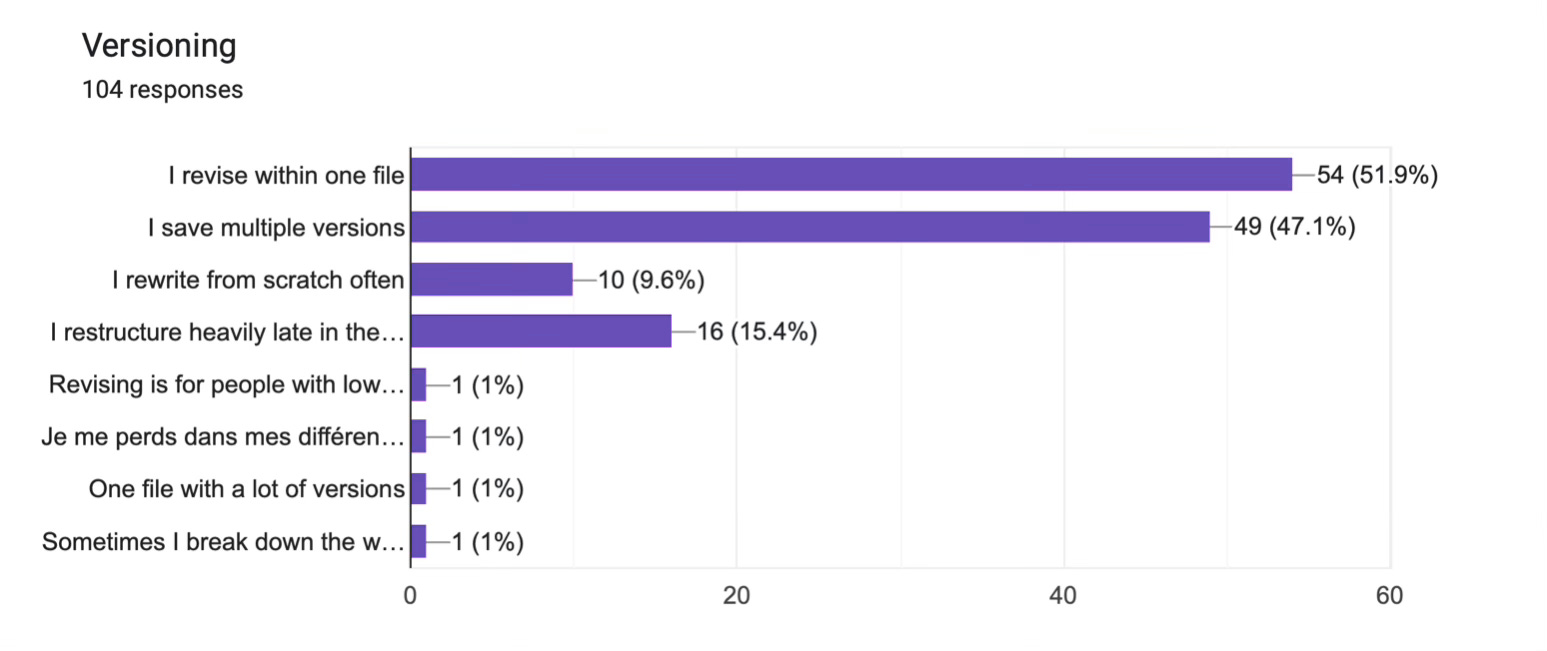
When it comes to versioning, again the main result is expected: the majority of people revise within one file. However, the difference between the number of those who keep multiple incremental versions is very narrow. So, truly you are not alone: someone does it the way you do, even if it is wildly inefficient (ten people rewrite from scratch, repeatedly). Now, here at Joyous Writing we pride ourselves on our acceptance of differences in the writing process. Whatever works for you, is our motto. However, the only time I had to rewrite from scratch a chapter in a book was a very unpleasant experience and I only did it because I realized that there was no way to salvage what I had written up to that point.
Much to my delight, one person chose my jokey answer “Revising is for people with low self-esteem.” Thank you, stranger!
In the next installment of the “You’re not alone” survey of writing preferences we will consider starting the writing process. Further down the road, the experience of flow, while writing.